50 Questions to Ask Before Marriage

The most useful questions to ask before marriage cover the areas where couples most often discover surprises later: money, family, children, daily life, values and the way you handle conflict. None of them has a right answer. What matters is that you both know the answers, can talk about differences with respect, and can imagine a plan.
How to hold these conversations
- Spread them out. Pick two or three per sitting. Fifty questions in one evening is too much.
- Choose a relaxed setting. A walk, a long dinner or a drive works better than a formal sit-down.
- Share first. Answer honestly yourself before judging the other's answer.
- Write things down. Notes help you remember and revisit as things change.
- Expect change. Answers evolve, so revisit them yearly.
Money (8 questions)
- What did you learn about money growing up?
- Are you a saver, a spender or somewhere in between?
- Do you have any debt, and how do you feel about it?
- How would we handle accounts: joint, separate or a mix?
- What amount of spending should we discuss before buying?
- What does financial security look like to you?
- How do you feel about supporting family members financially?
- What are our top three shared financial goals?
For a full format, see how to talk about money with your partner.
Family and in-laws (8 questions)
- How close are you with your family, and how close do you want to be?
- How often do you want to see family or have them visit?
- How should we handle holidays and traditions?
- What boundaries feel important with in-laws?
- How do we respond if a family member criticizes our choices?
- Who would we help if a relative needed care?
- What traditions from your family do you want to keep?
- How do we decide together when families disagree with us?
Children and parenting (7 questions)
- Do you want children? How many, and when?
- How do you feel if that timeline changes or doesn't go as planned?
- How were you raised, and what would you keep or change?
- How would we split childcare and household tasks?
- How do you feel about discipline?
- What would we do about work and childcare?
- What values do we want our children to carry?
Daily life and home (7 questions)
- What does a good ordinary week look like for you?
- How should we divide chores and the mental load?
- How much time alone and time with friends do you need?
- Where do we want to live, and what would make us move?
- How do you feel about pets?
- What are your sleep, food and tidiness habits?
- How do you recharge after a hard day?
Work, goals and the future (7 questions)
- What do you want from your career in the next five years?
- How would we handle one of us changing jobs or going back to school?
- What does work-life balance look like to you?
- What are your biggest dreams, and how can I help?
- How would we decide if an opportunity required moving?
- Where do you see us in ten years?
- What would a good retirement look like?
Values, faith and meaning (6 questions)
- What values matter most to you?
- What role does faith or spirituality play in your life, and how should it shape our home?
- What does being a good partner mean to you?
- What causes or communities matter to you?
- How do you define success?
- What are your deal-breakers, if any?
Communication and conflict (7 questions)
- How do you act when you are upset?
- What helps you calm down?
- How do you like to apologize, and how do you like to be apologized to?
- What is a topic we find hard to discuss, and why?
- How should we handle arguments in front of others?
- What does privacy mean to you, including phones and social media?
- How do we make sure each of us feels heard?
See couples communication exercises for practice.
If you disagree
- Get curious. Ask what experience or value sits behind the view.
- Find the shared goal. You might disagree on how to save and still agree that security matters.
- Separate the fixed from the flexible. Some things are deeply held. Others can change with a conversation.
- Make a trial plan. Try an arrangement for three months, then review it together.
- Get support if you are stuck. A premarital counselor or a trusted mentor can help.
Beyond the questions
Asking questions once is a good start, but the real value is the habit of staying curious. A weekly relationship check-in is a good way to keep talking after the wedding. If you want a lighter list, see couples questions to ask each other.
A structured way to work through them
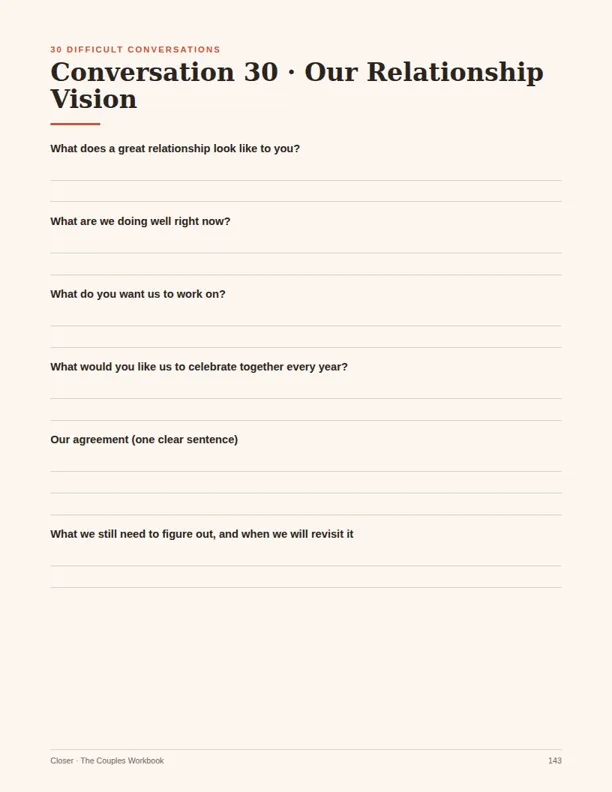
Closer — The Couples Workbook opens with Part 1, Know Each Other, which has 112 questions in eight categories, including family, money, the future, values and hopes and dreams, with lines to write your answers. It also includes 30 difficult conversations on topics such as spending styles, debt and savings, in-laws, children, household chores, the mental load, moving, career goals and your relationship vision, each with guide questions and space to record an agreement. A bonus, Money Talks for Couples, adds eight guided money conversations. The workbook is a tool for conversation, not a replacement for premarital counseling.