How to Talk About Money With Your Partner
The best way to talk about money with your partner is to schedule it, start with values and feelings before numbers, and keep the conversation to one topic at a time. Money is a leading source of stress in many relationships, and the stress is rarely just about the dollars. Money touches security, freedom, family history and fairness, which is why a casual comment about a purchase can start a fight.
This guide gives you ground rules, eight conversations to hold in order, and phrases to use when the topic feels tense. It is about communication and shared decisions, not financial advice.
Why money conversations get tense
- Different histories. One of you may have grown up with scarcity and the other with abundance, and each learned a different lesson about what money means.
- Different styles. Some people save by instinct and some spend to enjoy the present. Neither is wrong, but they clash when no one has talked about it.
- Hidden numbers. When one person handles everything, the other may feel in the dark, and the first may feel alone with the weight.
- Timing. Bills at the kitchen table at 10 p.m. are a poor setting for an open talk.
Ground rules before you start
- Pick a time and place. Choose a calm window, away from screens, with enough time to finish. Avoid right after a purchase or a bill.
- Start gently. Open with your feeling and a request: "I'd like to understand how we each think about money. Could we talk for 30 minutes on Sunday?"
- One topic at a time. Do not mix debt, vacation plans and in-laws in a single sitting.
- No blame or labels. "You are careless with money" ends the conversation. "I get anxious when the balance is low" keeps it going.
- Pause if you need to. If either of you is flooded, take a break and agree on when to return.
- End with a next step. Even a small one counts: "We will each write down our top three goals."
The 8 conversations
Hold one a week, or whatever pace suits you. Each can take 30 to 45 minutes.
1. Where we each come from
Share your earliest memories about money and what your family taught you. Questions: What is the first thing you remember learning about money? Who handled money in your home? What did you worry about? Understanding each other's stories turns many arguments into curiosity.
2. Our full picture
Put the facts on the table together: income, regular bills, savings, debts. The aim is shared information, not judgment. If this feels vulnerable, say so.
3. Spending styles
Describe how you each naturally behave with money. Are you a saver, a spender, a planner, or an avoider? What purchases feel worth it to you? What makes you uncomfortable?
4. Goals and priorities
Talk about what you want money to do: a home, a trip, security, freedom to change jobs, giving. Write down three goals each, then compare and find overlap.
5. Debt and safety nets
Talk about any debts, how they affect each of you, and what a safety cushion means to you. This can be sensitive, so go slowly and aim for understanding before plans.
6. Yours, mine and ours
Decide how you will handle accounts, shared expenses and personal spending. Many couples use a mix: shared accounts for household costs and an agreed amount each for personal spending, no questions asked. There is no single right setup, only the one that you both agree to.
7. Big-picture decisions
Discuss larger choices: buying a home, having children, changing careers, helping family. Agree on how you will make big decisions together, including an amount above which you consult each other.
8. Keeping the habit
Set up a monthly money meeting, decide who prepares what, and agree on a quick way to raise concerns between meetings.
Phrases that keep it calm
| Instead of | Try |
|---|---|
| "You spend too much." | "I feel stressed when I see the card balance. Can we look at it together?" |
| "We never have money for what I want." | "I'd love to talk about how we can plan for what matters to both of us." |
| "Why didn't you tell me?" | "I'd like us to share big purchases ahead of time. What works for you?" |
| "That's a waste." | "Help me understand why this matters to you." |
A simple monthly money meeting
- Share one thing each of you appreciates about how the other handled money this month.
- Review spending against your plan, without blame.
- Check progress on one shared goal.
- Decide on any upcoming big expenses.
- Ask: What is one thing you need from me around money this month?
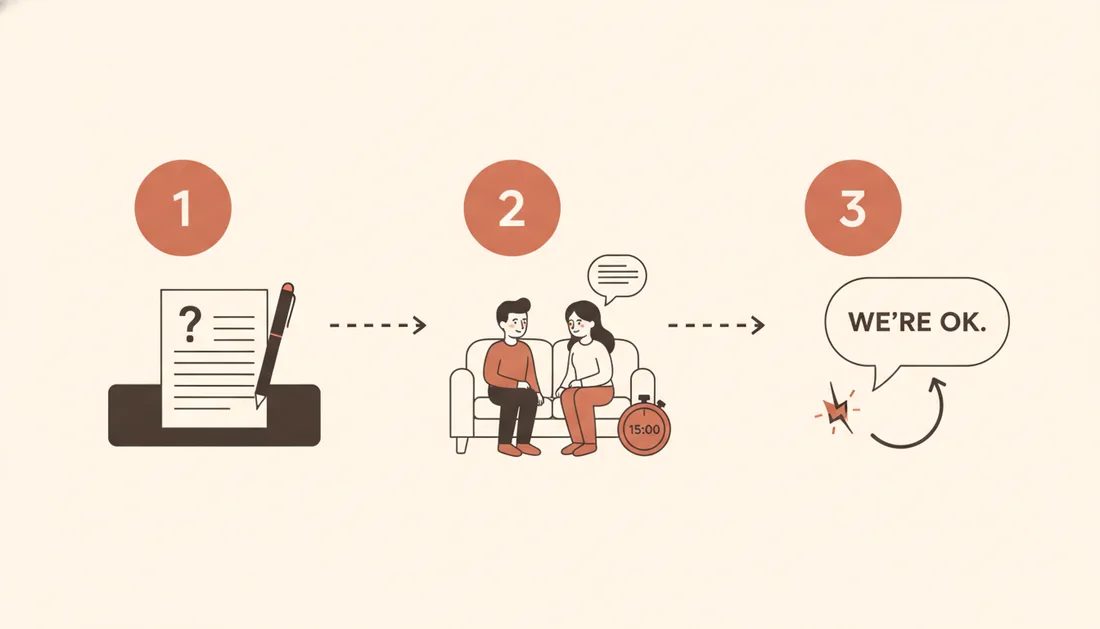
Thirty minutes is usually enough. Keep it consistent, and end on something positive.
Pair it with other conversations
Money themes often come up in other topics: family, kids, work and the future. The couples questions list includes a money category to get you started, and questions to ask before marriage covers money alongside values and family. A weekly relationship check-in can include a quick "money mood" question so concerns are heard early.
When to bring in a professional
For tax, investment, debt-repayment or legal decisions, talk to a qualified financial professional. If money problems are tied to secrecy, control or fear, or if one partner is limiting the other's access to funds, seek support. In the US, the National Domestic Violence Hotline (1-800-799-7233) can talk through financial control as well as other kinds of abuse.
A ready-made set of conversations
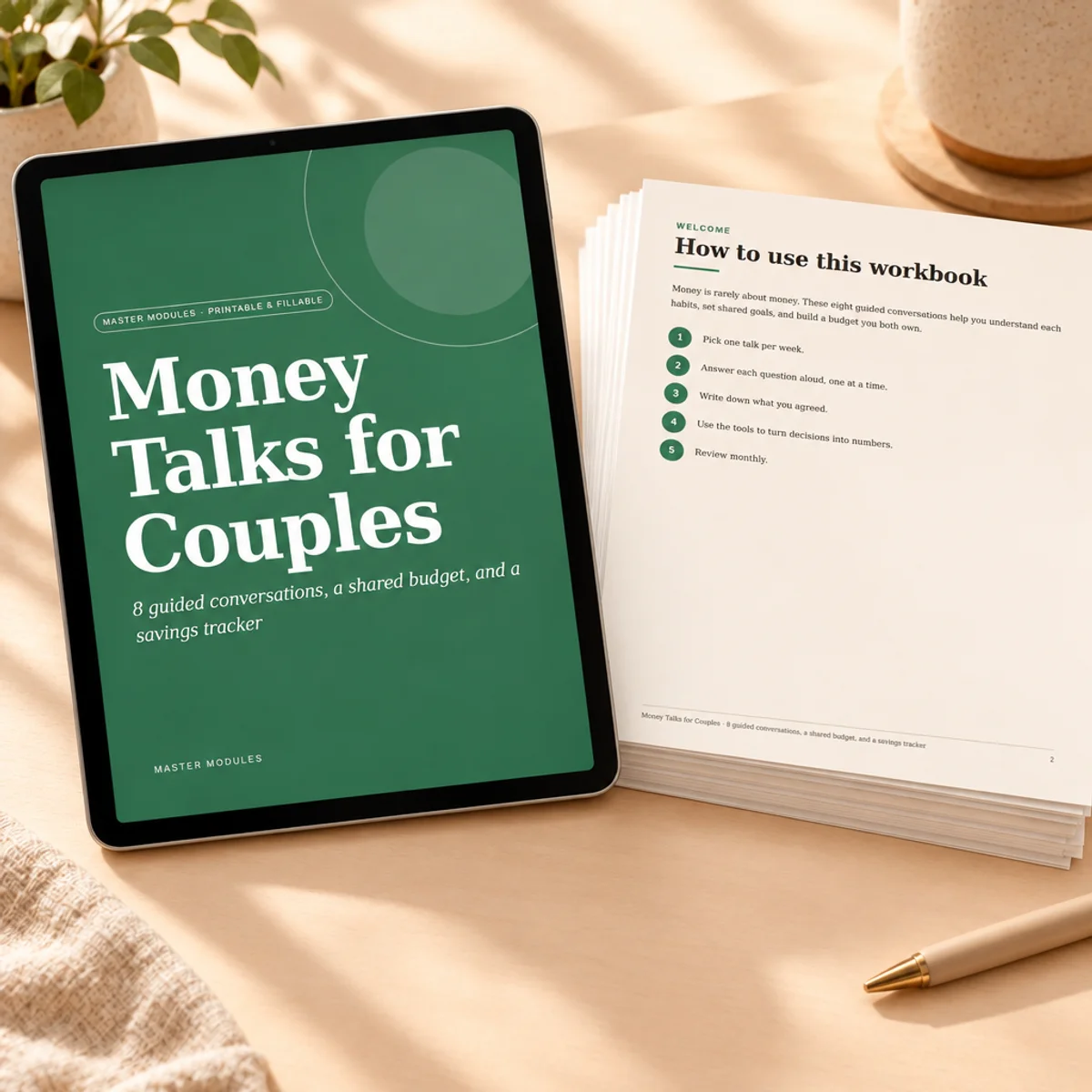
Closer — The Couples Workbook includes a bonus called Money Talks for Couples, with eight guided conversations that follow the order above, ground rules for money talks, a shared goals sheet, a monthly couple budget, a one-goal savings tracker and a Yours, Mine and Ours checklist. The main workbook adds a money category with 14 conversation questions and three money-focused difficult conversations: spending styles, debt and savings, and who pays for what. It focuses on talking and planning together; it does not give financial advice.