Relationship Check-In Questions for a Weekly Talk
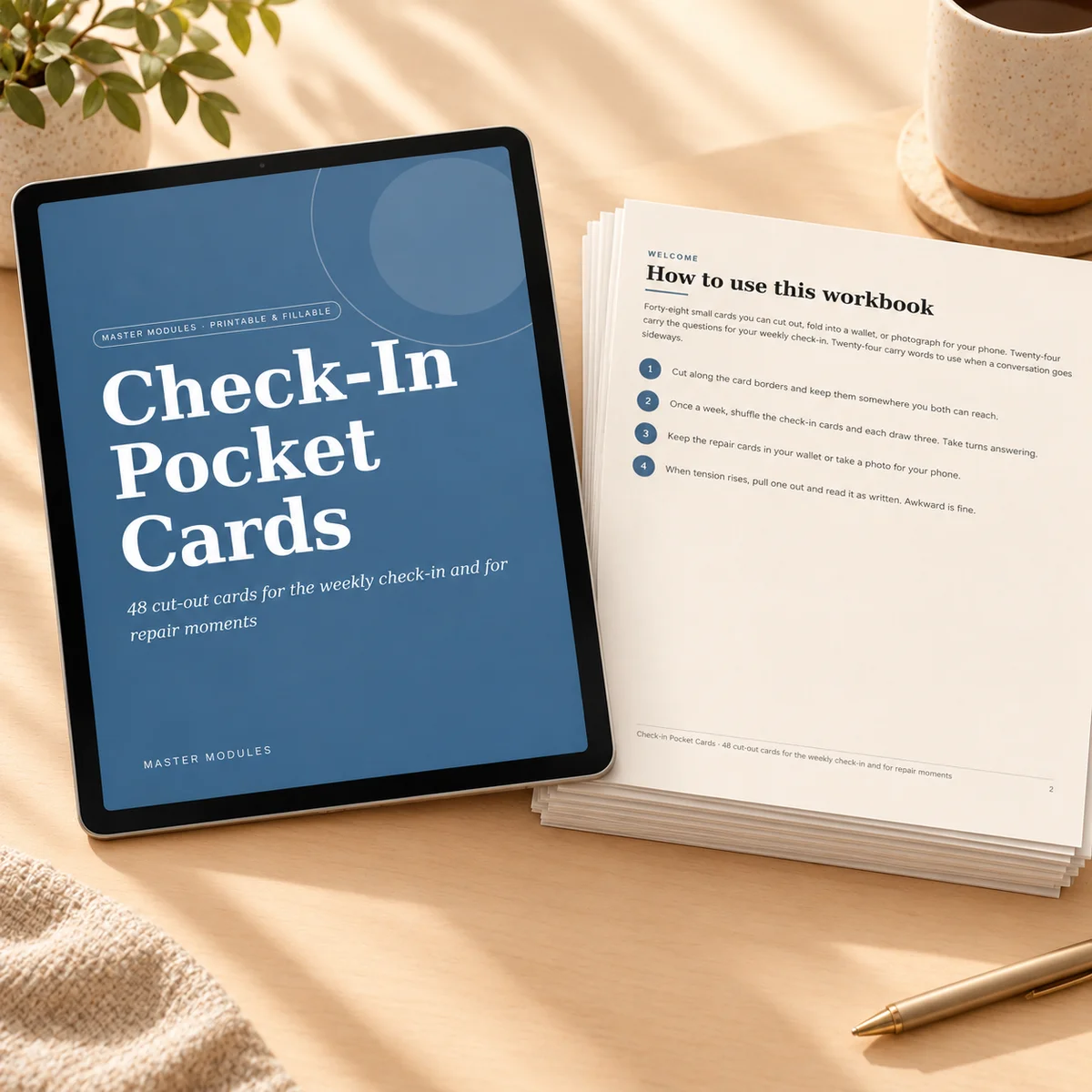
A relationship check-in is a short, scheduled conversation, usually once a week, in which you both share what is going well, what is hard and what you need. The aim is to catch small things early, appreciate each other and plan the week together. Fifteen minutes is enough.
Why a weekly check-in helps
Most couples talk plenty about schedules and chores but little about how they feel together. Without a time set aside, issues either pile up until they explode or never get discussed at all. A regular check-in makes it normal to bring things up, which lowers the pressure of each conversation. It also gives you a place to say thank you, which many people forget to do.
A 15-minute format
| Minutes | Step | What to do |
|---|---|---|
| 0–2 | Arrive | Put phones away, make a drink, sit together. Rate how you feel from 1 to 10. |
| 2–5 | Appreciations | Each of you names two things you appreciated this week. |
| 5–9 | What went well, what was hard | Each person shares one win and one challenge. The listener only reflects back. |
| 9–13 | Needs and requests | Each person makes one clear request for the week ahead. |
| 13–15 | Close | Agree on one thing to try and end with a hug or a thank-you. |
Ground rules
- Same time each week. Choose a slot that is realistic, such as Sunday evening.
- Start with the good. Appreciation first makes the harder parts easier to hear.
- Use "I" statements. "I felt overlooked when..." works better than "You always...".
- One topic at a time. If something big comes up, schedule a separate conversation.
- No fixing during the share. Listen and reflect first.
- Pause if needed. Take a break and agree when to return.
30 check-in questions
Pick two or three each week. You don't need to answer all.
Connection
- On a scale of 1 to 10, how connected did you feel to me this week?
- When did you feel closest to me?
- What is one thing I did that you appreciated?
- Is there anything you wish I had noticed?
- What would help us feel closer this week?
Stress and support
- What was the most stressful part of your week?
- How can I support you with that?
- Is there something you are carrying alone that we could share?
- How is your energy right now?
- What do you need more of: rest, time with friends, time with me, time alone?
Home and teamwork
- How did we do as a team on the chores and household tasks?
- Is there a task that feels unfair or heavy?
- What is coming up next week that we should plan for?
- Is there anything we need to decide together?
- How are we doing on our shared plans for money?
Communication
- Is there anything left unsaid from earlier this week?
- Did I say something that hurt or confused you?
- When did we talk well this week?
- What is one thing we could do differently in disagreements?
- Is there something you have been hesitant to bring up?
Affection and fun
- What made us laugh this week?
- Are you getting enough affection and attention from me?
- What is something small and fun we could do this week?
- What is a date or activity you'd love to do soon?
- Is there something I could say or do that would make you feel loved?
Looking ahead
- What are you looking forward to?
- What is one personal goal I can help with?
- What is one thing we want to keep doing?
- What is one thing we want to change?
- What is one thing we are grateful for as a couple?
A sample check-in, start to finish
Here is how a real one might sound, so you can picture it:
- Arrive. "I'm a six today. Long day at work."
- Appreciation. "Thank you for handling dinner on Tuesday. It took a weight off."
- Win and challenge. "My win was finishing the project. My challenge is that I feel I haven't seen you much."
- Request. "Could we have one evening this week with no screens?"
- Close. "Yes. Thursday. Let's keep it simple. Thanks for telling me."
Notice that nobody solved anything big. The check-in works because it keeps each person informed and appreciated, which is often what prevents bigger problems.
What to do when the check-in is hard
- If one of you is silent: Try the five-minute version and lower the stakes. Offer to go first.
- If it turns into blame: Say "I'm getting defensive. Can we reset?" and start again with appreciation.
- If you keep raising the same issue: Give it its own time and use a soft start-up. See couples communication exercises.
- If you feel disconnected overall: Read how to reconnect with your spouse.
Check-in worksheet fields
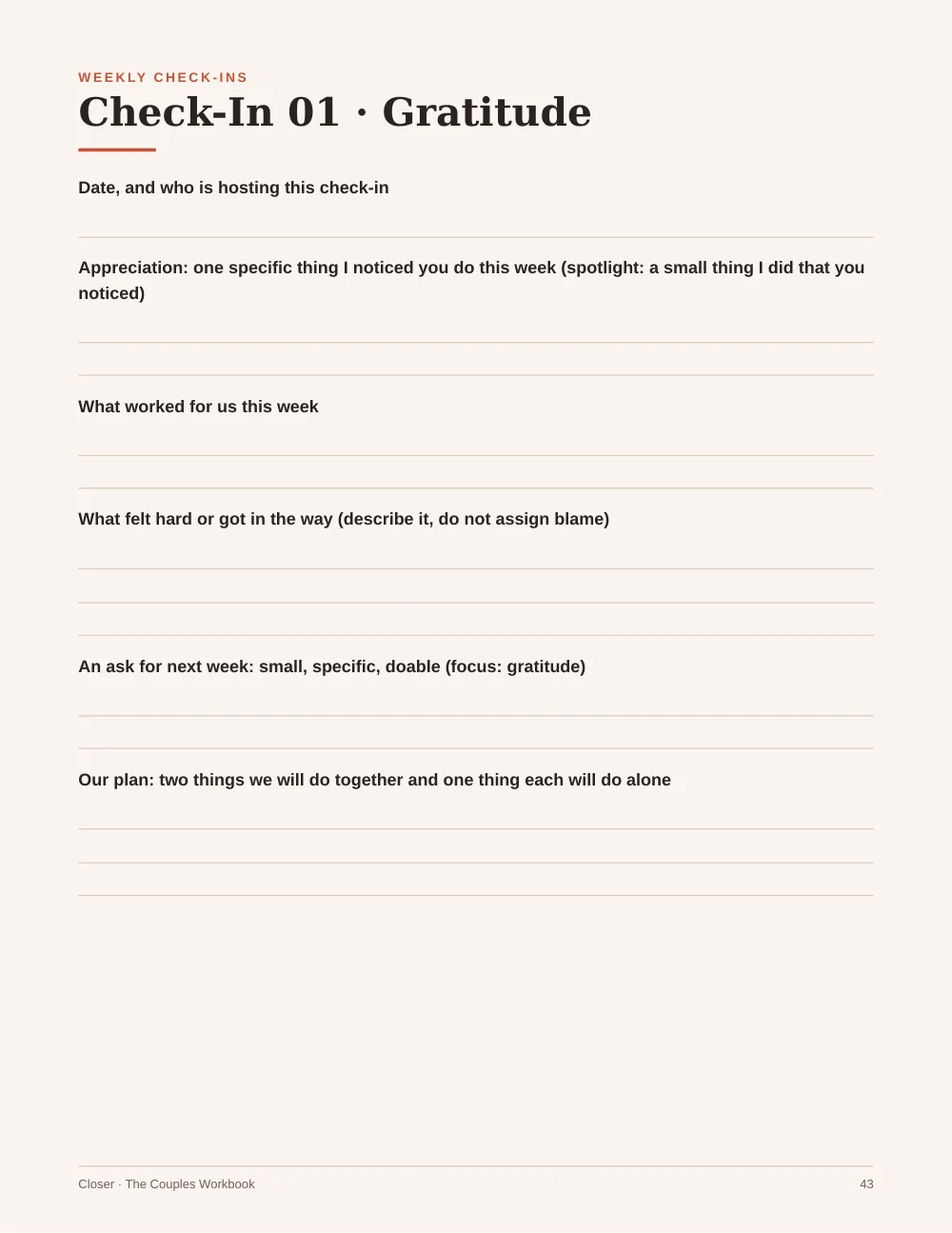
If you like to write, keep a simple sheet with these fields for each week: date, a 1 to 10 closeness rating for each of you, two appreciations, one win, one challenge, one request, and one thing to try. Over a couple of months, the ratings and notes show patterns that are hard to see in the moment. For other printable formats, see couples worksheets. Here is a free sample of the pulse check worksheet from the workbook, ready to print.
A full set of check-ins
Closer — The Couples Workbook includes 30 weekly check-ins of 15 minutes each, one for every week: gratitude, energy, money mood, home team, quality time, stress, affection, friends and family, work, fun, communication, health, dreams, trust, appreciation, rest, support, conflict, romance, growth, planning, space, kindness, memory, goals, boundaries, play, reflection, vision and celebration. A pulse check sheet appears every few weeks so you can rate how you are doing. The Check-In Pocket Cards give you 24 cut-out cards with the weekly questions, and the Closer app has a Check-In tool. For wider questions, see couples questions to ask each other.