Couples Communication Exercises
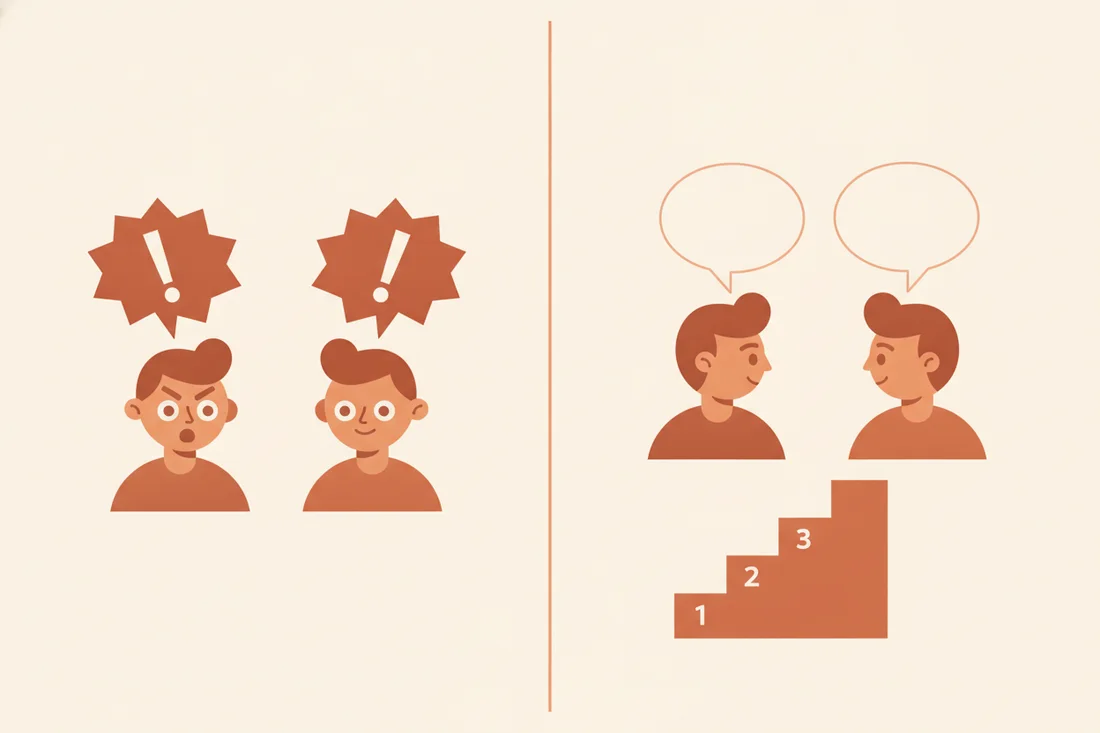
Good communication in a relationship is a set of habits: starting gently, listening before replying, repairing quickly and talking regularly. You can practice each one with short exercises. This guide gives you eight to try, with steps and sample phrases. They are practical tools for couples who want to talk better, not treatment for serious problems.
Before you start
- Choose a calm time and put phones away.
- Agree that these are practice, not a test.
- Decide on a signal for a pause, such as "time out" or raising a hand.
- Start with a low-stakes topic before you use any of them on a hot issue.
Exercise 1: The soft start-up
Why: Research by John Gottman suggests that how a conversation begins often predicts how it ends. A harsh start-up, with blame or criticism, tends to put the other person on the defensive.
How:
- State the feeling: "I feel..."
- Describe the situation, not the person: "when the dishes pile up."
- Say what you need: "I'd appreciate it if we could split them after dinner."
- Add appreciation or a connection: "I know you've had a long week."
Try it: Rewrite "You never help in the kitchen" as a soft start-up.
Exercise 2: Speaker and listener
Why: Many arguments are two people talking at once. Structure slows it down.
How:
- One person is the speaker and holds an object, like a pen.
- The speaker talks for two minutes about one topic, in "I" statements.
- The listener reflects back: "What I hear is... Is that right?"
- The speaker corrects or confirms.
- Swap roles.
The listener's job is to understand, not to agree or defend.
Exercise 3: The 5-minute daily opener
Why: Small daily moments build connection.
How: Each day, take five minutes. One minute to arrive, three minutes to ask and answer a question such as "What was the best five minutes of your day?", one minute to appreciate something. Phones off.
Exercise 4: The weekly check-in
Why: Regular talks prevent small problems from growing.

How: Once a week for 15 minutes, share an appreciation, a win, a challenge and a request. Read the full format in relationship check-in questions.
Exercise 5: The pause
Why: When your heart is racing, you can't listen well. A break helps your body settle.
How:
- Notice signs: raised voice, tight chest, urge to leave or shut down.
- Name it without blame: "I'm getting overwhelmed."
- Set a return time: "Can we take 20 minutes and come back at 8?"
- During the break, do something calming, not rehearsing arguments.
- Return as agreed.
Exercise 6: The complete apology
Why: A weak apology, such as "I'm sorry you feel that way," tends to make things worse.
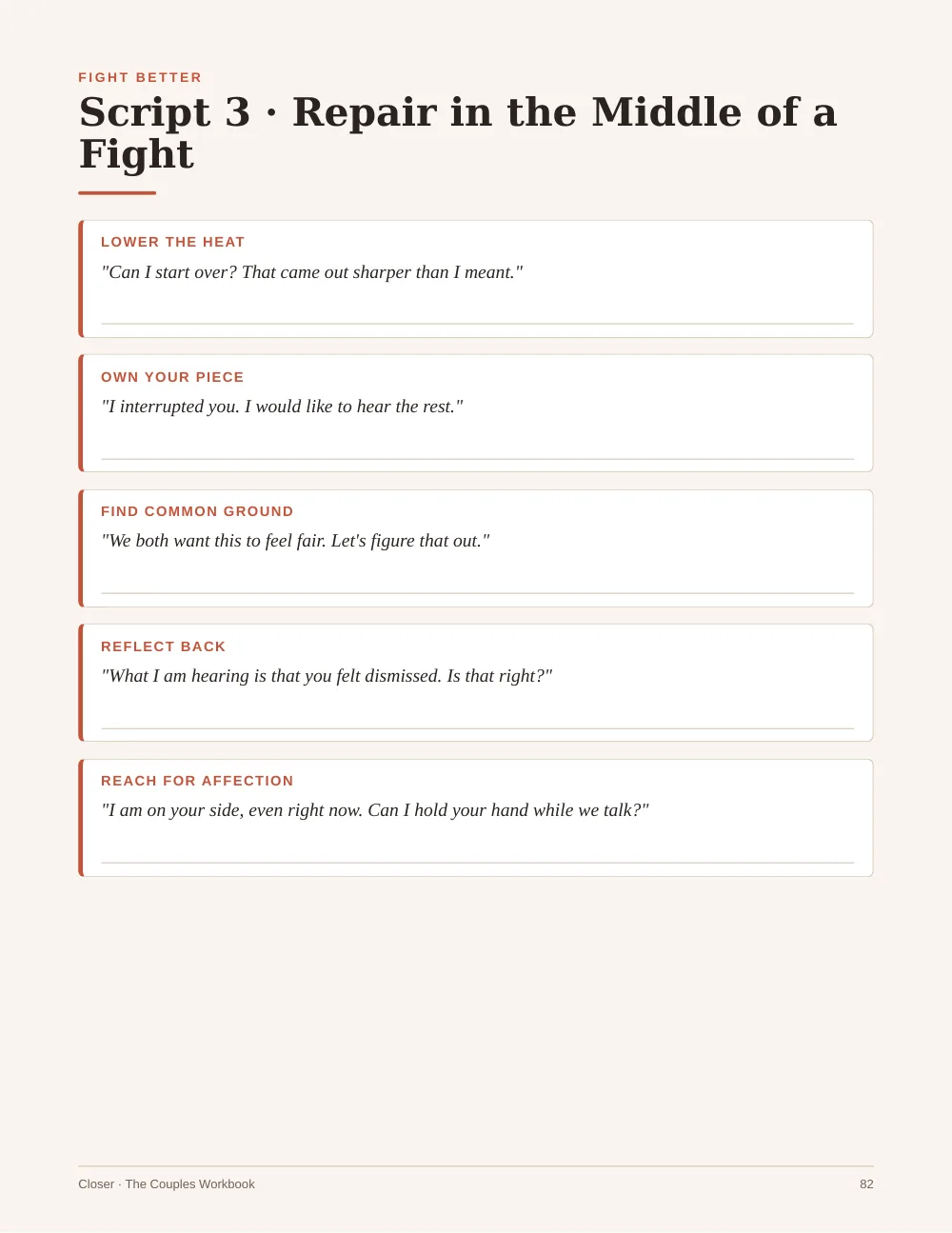
How: Cover five parts: what happened, the impact, your responsibility, what you'll do differently and what the other person needs. Practice with a small matter first. For more, see how to repair a relationship after a fight.
Exercise 7: Appreciation round
Why: Couples who regularly notice what's good have more to draw on when things get hard. Gottman's work describes a healthy ratio of positive to negative interactions, especially during conflict.
How: At dinner, each person names two specific things they appreciated about the other that day. Be specific: "Thank you for picking up the kids. I could breathe a bit because of it."
Exercise 8: Debrief after a disagreement
Why: A conversation after a fight lets you learn from it.
How: Within a day, sit together and answer:
- What was I feeling?
- What did I need?
- What triggered me?
- What did I do that made it harder?
- What one thing could we change next time?
Keep it to 15 minutes, and finish with something warm.
A sample 15-minute practice session
If you want one place to start, try this sequence once a week for a month:
- Minutes 0–2: Sit together, phones away, and each rate your day from 1 to 10.
- Minutes 2–5: Do the appreciation round (exercise 7) and name two specific things.
- Minutes 5–11: Choose one small topic and use the speaker and listener format (exercise 2), three minutes each.
- Minutes 11–15: Agree on one small thing to try this week and end with a hug.
Notice what feels natural and what feels forced. Keep what works, and drop what doesn't. The goal is a rhythm you can keep, not a perfect performance.
Which exercise for which situation
| Situation | Try |
|---|---|
| Starting a hard topic | Soft start-up (1) |
| Feeling unheard | Speaker and listener (2) |
| Feeling disconnected | Daily opener (3), Weekly check-in (4) |
| Escalating argument | Pause (5) |
| After hurting each other | Complete apology (6), Debrief (8) |
| Feeling taken for granted | Appreciation round (7) |
Make it stick
- Pick one exercise and practice it for two weeks.
- Add a second one only when the first feels natural.
- Keep a short note of what worked.
- Celebrate small wins: "That conversation went better than last time."
- Return to the basics under stress. Pause, soft start-up, listen.
When exercises are not enough
If you feel unsafe, if there is threat or physical aggression, or if you are dealing with betrayal, addiction or a crisis, seek help from a licensed professional. The National Domestic Violence Hotline (1-800-799-7233) is confidential and available at any time. Trust and recovery are covered in how to rebuild trust after a rough patch.
A workbook that puts these into practice
Closer — The Couples Workbook has a section called Fight Better that gives you five scripts: pause a discussion, soft start-up, repair in the middle of a fight, a complete apology, and coming back after a fight. It also has a page for your own rules for fighting fair, an after-a-fight debrief sheet, 30 weekly 15-minute check-ins, 30 guided difficult conversations and a set of Check-In Pocket Cards, 24 of which carry repair phrases. A five-minute quick-start guide helps you begin tonight. For question ideas, see couples questions to ask each other.