How to Repair a Relationship After a Fight

To repair a relationship after a fight, calm down first, then come back within a day to name what happened, own your part, listen to the other side fully, and agree on one change. The fight itself matters less than what you do afterward. Couples who last tend to be the ones who learn to reconnect, not the ones who never argue.
Why repair matters more than winning
John Gottman's research on couples has long highlighted the role of "repair attempts," the small things partners say or do to stop an argument from escalating, such as humor, an apology or a request to start over. Whether a couple can make and accept repair is one of the things that separates stable relationships from fragile ones. This is good news because repair is a skill: it can be learned and practiced.
Step 1: Pause when you are flooded
If your heart is racing, your voice is rising or you are saying things you would not normally say, you are probably too upset to talk productively. Say something like: "I'm too upset to do this well. I need 30 minutes, and then I want to come back to it." A pause works when it has an end time and the person asking for it does return.
During the break, do something that calms your body: walk, breathe slowly, drink water. Do not use the time to rehearse your best arguments.
Step 2: Choose a calm moment to come back
Return within 24 hours if you can. Look for a time when neither of you is hungry, rushed or distracted. Open gently: "I'd like to talk about last night. I want us to feel okay again." A soft start-up, which means starting with your feeling and a request instead of blame, makes it much more likely the conversation will go well.
Step 3: Say your side briefly, then listen fully
Each person gets a turn. Keep yours short and focused on the situation, your feelings and what you need:
- Situation: "When we were talking about the plans for Saturday..."
- Feeling: "I felt dismissed."
- Need: "I need to feel like my input matters."
Then reflect back what you heard before responding: "So you felt rushed, and you needed more time to decide. Is that right?" Reflecting back is awkward at first but it prevents the common problem of arguing against something the other person did not say.
Step 4: Own your part
Almost every argument has two contributors. Finding your piece, even if it is small, changes the conversation: "I raised my voice, and that was not okay." Avoid "I'm sorry, but..." because the "but" cancels what came before.
A complete apology has five parts:
- What happened ("I interrupted you and used a sharp tone.")
- The impact ("That probably made you feel unheard.")
- Responsibility ("That was on me.")
- What you will do differently ("Next time I'll ask for a pause instead.")
- What the other person needs ("Is there anything else you need from me?")
Step 5: Agree on one small change
You cannot solve everything in one talk. Pick one thing each of you will do differently: "If we start to argue about money, we'll pause and sit down on Sunday." Write it down. Small, specific agreements are more likely to stick than general promises such as "I'll try to be better."
Step 6: Close with connection
End the repair conversation with something warm: a hug, a thank-you, a plan for the evening. Repair is not complete until you feel reconnected, not just until the problem is "solved." Many couples find it helps to do something light together afterward, like a short walk or a favorite show.
Word-for-word scripts
| Moment | Script |
|---|---|
| Asking for a pause | "I'm getting overwhelmed. Can we take 20 minutes and come back at 8?" |
| Coming back | "I've calmed down and I'd like to talk about earlier. Is now a good time?" |
| Taking responsibility | "I did X. I can see how it hurt. I'm sorry." |
| Receiving an apology | "Thank you for saying that. It helps." |
| Adding a boundary | "I want to work this out, and I need us both to avoid name-calling." |
For a longer rough patch
If you are dealing with more than one argument, such as weeks of distance or a series of conflicts, the same basics apply but at a slower pace:
- Agree on ground rules for how you will talk.
- Hold a weekly check-in to share what is hard and what is going well.
- Rebuild small daily habits, such as a greeting, an evening question and a thank-you.
- Revisit the conflict when you both feel steady.
For a deeper look at the trust side, read how to rebuild trust after a rough patch.
When to get help
If fights involve fear, threats, name-calling, contempt or physical aggression, or if repair attempts fail again and again, consider a licensed couples counselor. If you are in danger, call 911. The National Domestic Violence Hotline (1-800-799-7233) offers support at any hour.
Practical tools for repair
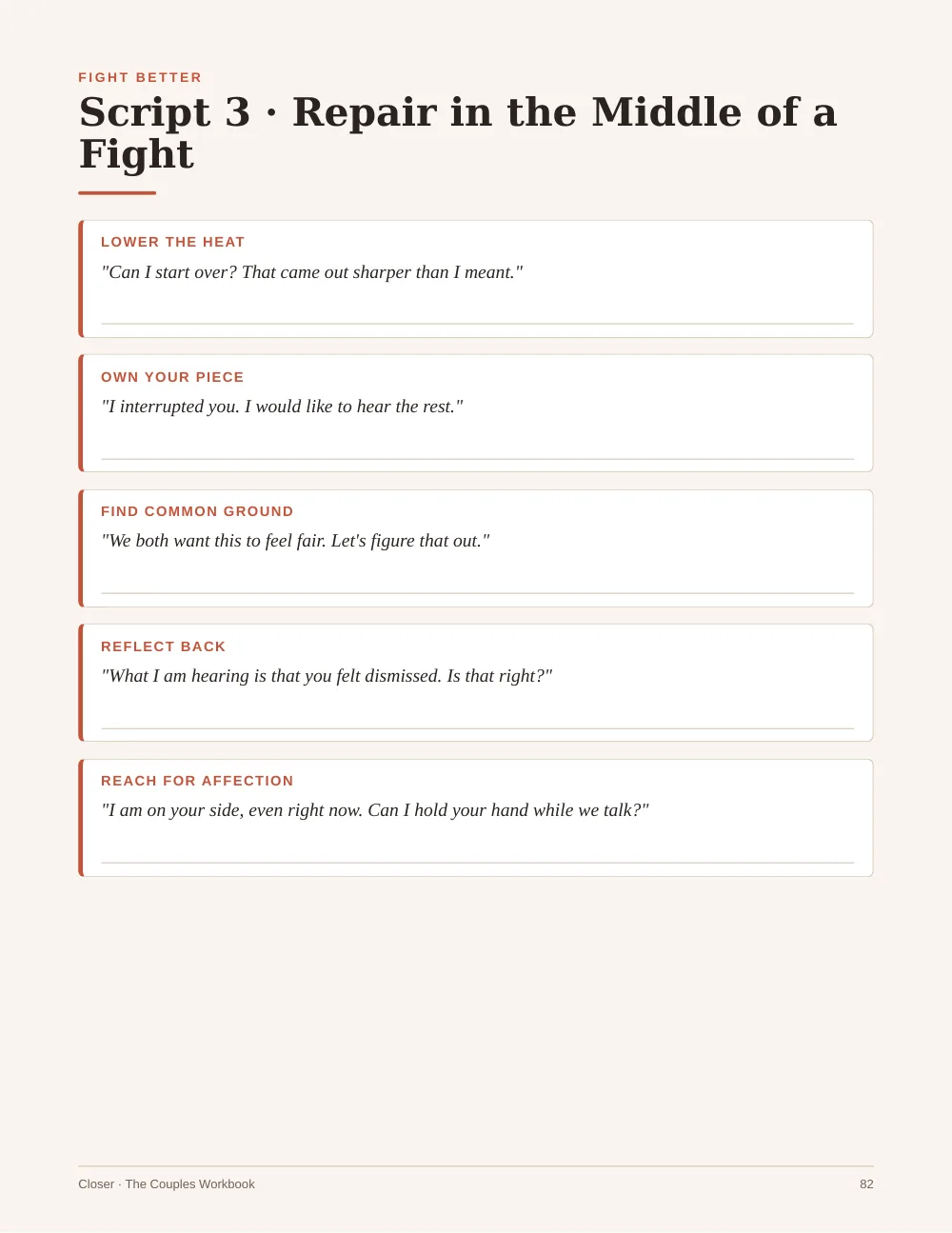
Closer — The Couples Workbook includes tools aimed at these exact moments. It has five scripts under Fight Better: pausing a discussion, a soft start-up, repair in the middle of a fight, a complete apology, and coming back after a fight. It also includes a debrief sheet for after a disagreement, a page for your own rules for fighting fair, 48 pocket cards (24 with repair phrases), and 30 weekly check-ins you can use to keep communication open. The Closer app has a Repair tool as well.
Two other products connected to repair, the Reconnect After a Rough Patch Sheets and the 30-Day Repair Plan, are separate paid add-ons and are not part of the workbook.
For practice before the next hard moment, see couples communication exercises. If distance is the bigger issue, try how to reconnect with your spouse.