How to Rebuild Trust in a Relationship
Trust is rebuilt through changed behavior that is repeated over time, honest conversation about what happened, and small promises that are kept. It is not rebuilt by one apology, a grand gesture, or by telling the other person to move on. This guide is for couples going through a rough patch, such as broken promises, a period of distance, secrecy about money or time, or repeated arguments that eroded confidence in each other.
It describes conversations and habits only. It is not a treatment for serious breaches, and it is not a substitute for a licensed counselor.
Before you start: safety and readiness
Trust work only makes sense when both people are safe and willing.
- If you feel afraid of your partner, controlled, or threatened, stop and seek help first. In the US, the National Domestic Violence Hotline (1-800-799-7233) is confidential and available at any hour.
- If one person is not ready to talk, forcing it will backfire. Offer a time later in the week.
- If the issue involves infidelity, addiction, or something that calls for specialized help, bring in a licensed professional. Exercises can support that work, but they should not replace it.
What trust actually is
Trust is a prediction: "When I need you, you will be there, and what you say matches what you do." After a rough patch, that prediction is shaken. You rebuild it the way it was built in the first place, through many small moments when words and actions line up. Researchers who study couples, such as John Gottman, describe trust as built in small moments of showing up. That helps explain why one dramatic gesture rarely works and why steady, boring reliability does.
7 steps to rebuild trust
1. Name what happened in plain words
Both of you need a shared, honest description of what went wrong, without spin. The person who broke trust says it clearly: "I told you I would be home and I wasn't, and I didn't call." The person who was hurt says how it affected them: "I felt dismissed and started to wonder what else I wasn't being told." Keep it to facts and feelings, and avoid assigning motives you cannot know.
2. Take responsibility without excuses
A complete apology has several parts: say what you did, name the impact, take responsibility, say what you will do differently, and ask what the other person needs. Explanations are fine, but "I'm sorry you feel that way" or "I'm sorry, but..." tends to undo the apology.
3. Let the hurt partner set the pace
The person whose trust was damaged often needs to ask questions, repeat them, or need reassurance more than once. That is not punishment; it is processing. The person who caused the hurt can help by answering calmly and consistently rather than getting defensive.
4. Make small, specific promises and keep them
"I will be better" is hard to measure. "I will text when I'm going to be more than 20 minutes late" can be seen and tested. Choose one or two small commitments each, write them down, and review them in your weekly check-in. Keeping small promises is the most direct way to rebuild reliability.
5. Increase transparency in agreed ways
Depending on what happened, openness might mean sharing a calendar, being clear about spending, or telling each other when plans change. Agree on what and for how long. Transparency is a bridge while trust returns, not a permanent surveillance system, and both partners should be comfortable with the terms.
6. Create regular, protected time to talk
Set a weekly check-in of 15 to 30 minutes, at a time when you both have energy. Ask: What has felt better this week? What was hard? What do I need from you? What can I do for you? See relationship check-in questions for a format.
7. Notice and name progress
Rebuilding trust can feel slow, and people tend to notice setbacks more than steady gains. Make a habit of saying so when it goes well: "Thank you for calling. It helped me relax." Positive attention strengthens the pattern you want more of.
Words that help
| When | Try saying |
|---|---|
| Starting the conversation | "I want to talk about what happened because I care about us. Is now okay, or would later be better?" |
| Apologizing | "I did X. I know it hurt you because Y. I take responsibility. Here is what I will do differently." |
| Listening | "Let me make sure I understand. You felt X when Y happened. Is that right?" |
| Asking for reassurance | "I'm having a hard moment. Could you tell me what you're thinking?" |
| Taking a pause | "I'm too upset to talk well. Can we pick this up in an hour?" |
Common mistakes
- Rushing forgiveness. Forgiveness is a process, not a deadline.
- Using the past as a weapon. Revisiting the issue in every argument keeps the wound open. Agree on when and how it will be discussed.
- Trying to fix everything at once. Pick one pattern to work on first.
- Measuring by feelings alone. Look at behavior over weeks, not at one day.
A 30-day rhythm you can try
Use this outline as a guide for a month, adjusting to your situation:
- Week 1: Set ground rules for how you will talk, and calm things down. Aim for short conversations that end well.
- Week 2: Choose small daily habits and keep one promise each.
- Week 3: Share what each of you needs to feel safe, and agree on transparency.
- Week 4: Reflect on what has changed, and plan the next month.
When to get outside help
Consider a licensed couples counselor if you keep having the same fight, if the breach is serious, if trust feels impossible to rebuild alone, or if you are not sure the relationship should continue. Asking for help is not a failure. It is often the most effective step available.
Tools to keep the conversations going
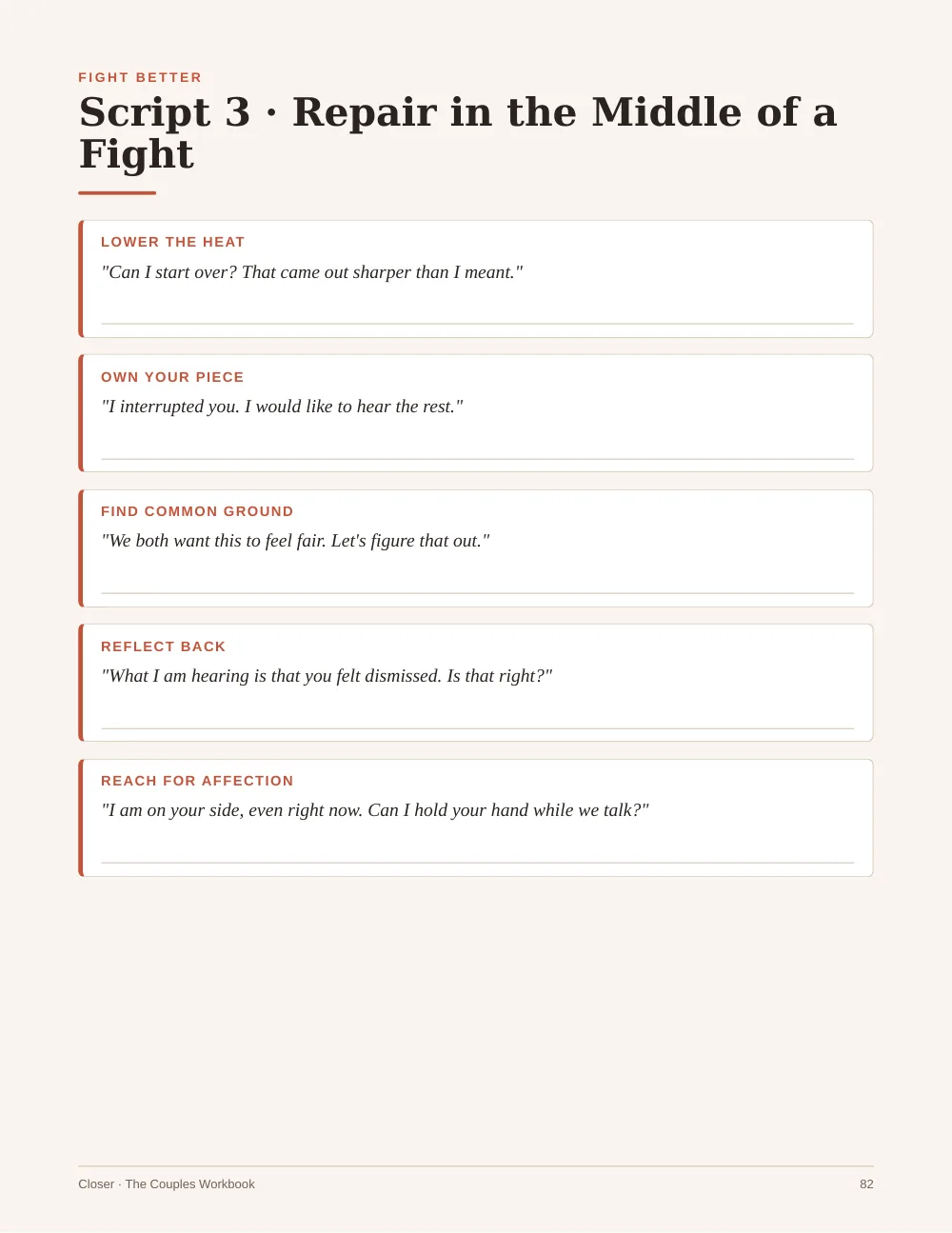
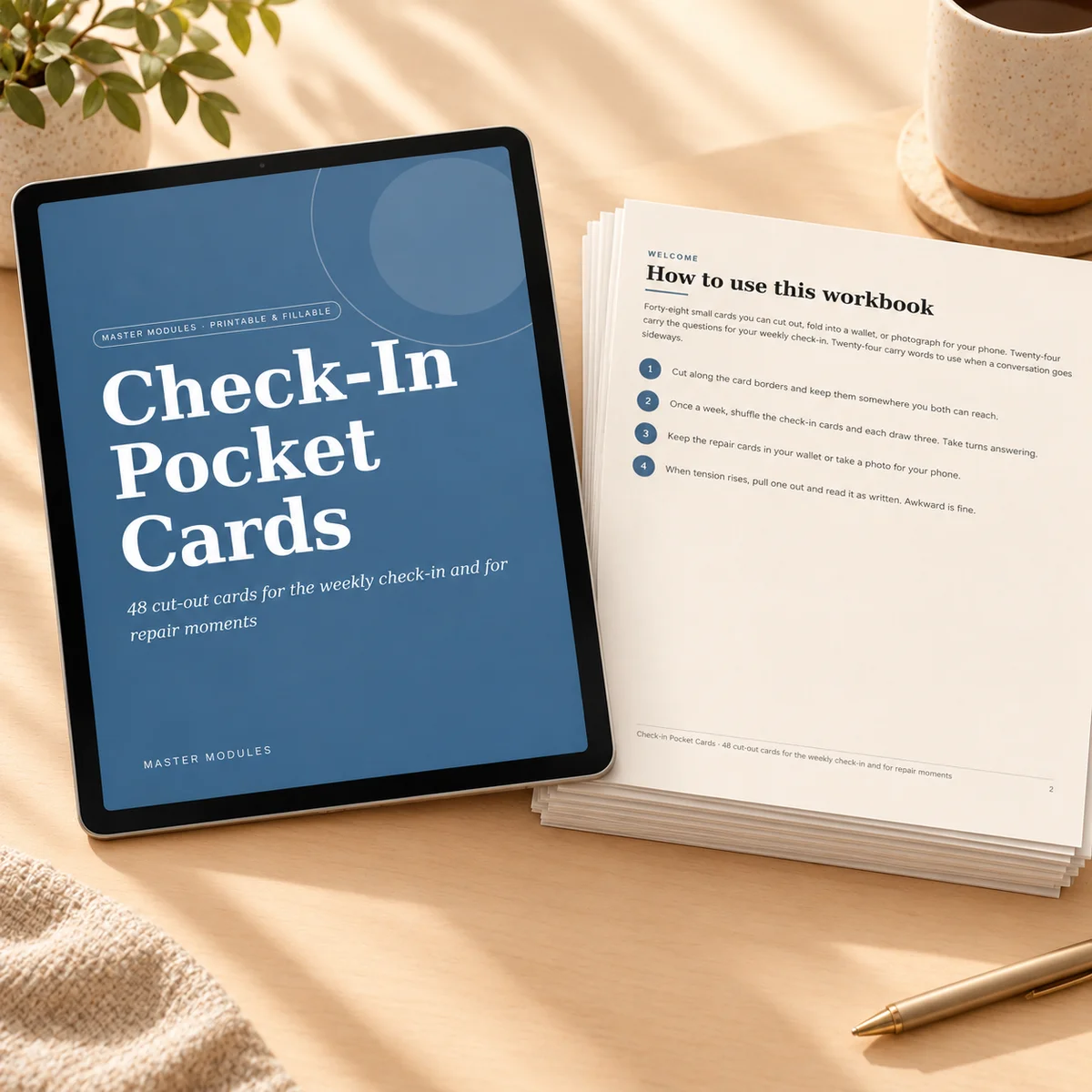
Closer — The Couples Workbook is a printable workbook with conversation tools for couples. It includes five scripts for tough moments (pausing a discussion, a soft start-up, repair in the middle of a fight, a complete apology and coming back after a fight), a debrief sheet for after a disagreement, 30 weekly check-ins that include trust and conflict themes, and 48 pocket cards, 24 of which carry repair phrases. It is not a repair program for serious breaches; a separate 30-Day Repair Plan is a paid add-on sold apart from the workbook.
Next, read how to repair a relationship after a fight and couples communication exercises.